Friday, July 31, 2009

Struggle In The Soul

Humanity is going through the most important stage in the course of its existence. Our present time is marked by difficult global challenges which mirror a serius fork in the road. There are just two directions, two rivers. One goes up. The other goes down. And the way we choose depends on each one of us. It's a question of becoming really conscious human beings or degenerate into sub-human species.
The core of this difficult situation is the most ardent of the struggles, the internal one.
Be kind to all you meet for all are engaged in a life and death struggle (Plato). Not seeing it in ourselves means one is dead already and has succumbed to the dark side of the force. Darkness destroys, excludes and divides. Therefore, to become really conscious, darkness should never be avoided or feared, but rather included. Two poles interacting make light.
St.George's Dragon can never be destroyed. We all need to face our inner dragons: fears, repressed emotions and instincts. And winning means not succumbing to unconsciousness.
When an inner content is not made conscious, it happens outside as Fate (C.G.Jung).
All the destruction, scandals and aberrations that the criminal mass media displays with such a shameful morbosity is an explosive externalization of all the elements humans repress.
Therefore, the responsibility of not supporting darkness falls upon man. We carry the world upon our shoulders, like Atlas.

Monday, June 8, 2009

The Absence Of God Is The Presence of God

The words we use to describe the world rarely grasp the richness of a given moment. Nevertheless, the power of words can still be real.
In the context of the Gnostic path of love, Cynthia Bourgeault expresses her teacher´s wisdom (we highlighted a few inspiring sentences):
Rafe began his hermit life. It was an exhilarating time for him in its new found freedom, but the strain of loneliness and disorientation -not to mention the sheer physical brutality of the site- gradually took its role. Late one afternoon he was in a thickly tangled, rock-strewn field, trying to move a large boulder to clear a site for his cabin. He strained and strained with pickax and crowbar, but the boulder wouldn't give.
"And suddenly I burst into tears" he said. "I was so tired; it all just felt so lonely, so totally useless. I sat there on that rock and said to myself, 'Listen, God didn't ask you to come here, you came here yourself'.
"I'd never felt that way before. It was an ache all the way to the end of the universe. I realized this must be my 'bare self'.
Over those next long months, Rafe said he gradually became acostumed to it. That ache all the way to the end of the universe was how things would be, how they had to be. "God can only work in us through our bare self", he averred. "At that place, if a person is really willing to wait there, god says, 'Aha! now we can get down to work. At last there is something to work with'".
Later, in an astonishing observation, Rafe added, "we only think it's bare because the light is so intense that it blinds us".
Again and again Rafe taught me to work this way, not flinching from those moments of utter unremitting emptiness. "You have to endure the tedium until something gradually emerges in it" he told me, the lesson of those long, empty winters up at the cabin. In it, not from it, he insisted. It is not the incubator of the new; it is the new itself, in the beginning of its own dimensionality, stark and pitilessly embracing.
Sometimes, he said, he'd cry out with terror. With the ache and futility of it. With a life wasted, a God far away. "That's the beginning of it. That's when you're getting somewhere. If you can only just stay present in that bare self, you'll begin to discover how the absence of God is the presence of God".
We are human. We want to jerk away from that moment. Fill it with distraction and activity, with our own meaning. In my case, run up the hill to Rafe's cabin, fill it with a person, sitting in his chair in his lonely winter watch -a person, my heart told me, who would too soon be gone. Fill it with a conversation, a cappucino, the energy flowing between us, the joy of times shared, the glow of human love. But to live in that world, to warm oneself only by its fire, means to be stranded in unbridgeable, wrenching loss when that fires flickers out. To find the eternal communion, one must not be afraid to venture into that dark, black sea of what seems inexpressible absence. More painfully, one must 'choose' to venture out, while the fire is still burning on the shore. For only what is truly begun here can continue in eternity.
Dwell in it...endure the tedium until something gradually emerges in it. Often now, I lie in my bed and simply ache. But I try to remember that this ache is what is given to me in this moment to express the presence itself; to paraphrase Rilke, it is the beginning of a love I can just scarcely bear in human form. In the cosmic sphere everything is a two way street. By that very ache I know I am still connected in love; it is the bridge on which I cross. I remember Rafe saying, "it seems bare only because it's so full of light".
"If I can love you across the space of a mile, I can love you across the space of eternity" excerpted from the book Love is Stronger Than Death

Monday, May 11, 2009

The Dark Night Of The Soul

One of the greatest spiritual literature jewels is the poem Dark Night, written by a the Spanish mystics, Juan de Yepes Alvarez, also known as Saint John of the Cross (1542-1591), a Carmelita monk who worked closely with Therese of Avila, another important mystic.
He wrote this poem after enduring tortures and a nine month incarceration, for disobeying his superiors and wanting to make reforms in his order:
On a dark night,
Kindled in love with longings
Oh happy chance!
I went forth without being observed,
My house being now at rest.
In darkness and secure,
By the secret ladder, disguised
Oh happy chance,
In darkness and in concealment,
My house being now at rest,
In the happy night,
In secret, when none saw me,
Nor I beheld aught,
Without light or guide,
Save that which burned in my heart,
This light guided me
More surely than the light of noonday,
To the place where he
Who I knew well! was awaiting me
A place where none appeared.
Oh, night that guided me,
Oh, night more lovely than the dawn,
Oh, night that joined
Beloved with lover,
Lover transformed in the Beloved!
Upon my flowery breast,
Kept wholly for himself alone,
There he stayed sleeping,
and I caressed him,
And the fanning of the cedars made a breeze.
The breeze blew from the turret
As I parted his locks;
With his gentle hand
He wounded my neck
And caused all my senses to be suspended.
I remained, lost in oblivion;
My face I reclined on the Beloved.
All ceased and I abandoned myself,
Leaving my cares
Forgotten among the lilies.
The expression "dark night of the soul" is very used in the mystic literature and it sometimes refers to states of emotional distress and existential ordeals. However, in this poem, the dark night indicates a state of silent stillness (hesychía) in the depths of oneself.
Saint John of the Cross wrote abundantly on the experience in two wonderful books, The Dark Night of The Soul and Ascent of Mount Carmel. The poem basically describes the spiritual surrender and profound inner stillness -My house being now at rest- which led John to the realisation of divine oneness inside, Oh, night that joined Beloved with lover.
The experience of this sacred night beyond "ordinary" thoughts and perceptions after his moments of suffering entail the transcendence and integration of those moments, which served as part of the purification process, the defeat of the selfish personality.
This inspired mystic explained the spiritual purification as having two stages: the purification of the senses, which is the cleansing of our ordinary perceptions, and the spiritual catharsis, which deals with the hurdles of sloth, self-pity, envy and lack of faith: the dark night of the soul is the arising of God inside the soul, which is stripped of her ignorance and imperfections: habitual, natural and spiritual; being summoned by contemplations saturated with divine knowledge. Thus, God teaches her secretly and instructs her in his perfection of love, without doing anything or without understanding the nature of the contemplations (The Dark Night of the Soul).
Spiritual purification takes place by going through, and digesting, emotional suffering such as deep sorrow, despair, boredom, sourness; symptoms which arise before and during the process of inner growth. They are even experienced by yoguis and monks. The solitary and ascetic Fathers of the Desert, for instance, talked about acedia, a sort of sloth and boredom which was considered a kind of sin, a manifestation of the false ego.
As for the importance of dwelling in silent stillness, beyond the distraction of the senses, St.John wrote: the way in which these souls [the spiritual seekers] are to conduct themselves in this night of the senses [beyond sense perceptions], is to devote themselves not at all to reasoning and pondering, since this is not the time for it, but to allow the soul [psyche] to remain in peace and quietness, although it may seem clear to them that they are doing nothing and are wasting their time, and although it may appear to them that it is because of their weakness that they have no desire in that state to think of anything.
The truth is that they will be doing quite sufficient if they have patience and persevere in prayer, without making any effort. What they must do is merely to leave the soul free and disencumbered, and at rest from all knowledge and thought, troubling not themselves in that state, about what they shall think or meditate upon, but contenting themselves with merely a peaceful and loving attentiveness towards God and in being without anxiety, without the ability and without desire to have experience of him or to perceive him. For all these yearnings, disquiet and distract the soul, from the peaceful quiet and sweet ease of contemplation which is here granted to it (The Dark Night Of The Soul).
This ability to remain immersed in pure awareness and stillness is considered to be the higher level of prayer by the mystics. Be still and know that I am God (Psalm 46, 10).
The hesychast master St.Theophan the Recluse taught that there are three levels of prayer: the prayer of the mind, the prayer of the heart and the prayer of the body, which integrates the previous ones in the pure space of awareness; it's not a simple physical sensation, but a consciousness that integrates mind, feeling and body in quietness. This is an extremely clarifying teaching, in so far as it dispels all those pseudo-mystic misinterpretations that preach an absolute annihilation of mind and feeling in higher states of being.
There are higher degrees of feeling and thinking which must be actualised in order to tap into infinity. These degrees of objective knowledge (divine contemplations, says St.John) include what we could call "causal mysticism", where the seeker leaves the ordinary senses behind and plunges into the feminine side of reality, a dark vastness of potentialities devoid of form. The Sufies call it Alam i Imkan, the world of possibilities. That might be what St.John seems to be hinting at.
Althought this causal state is only one side of the cosmic equation. Our task is experiencing it and make this infinite energy flow into the world of multiplicity. For the form is emptiness and emptiness is form (Sutra of the Heart).

Monday, April 6, 2009

Incubation, A Western Form Of Meditation

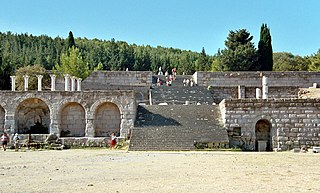
Dream Temple of Kos

The forgetfulness regarding Western roots is mirrored in the way occidental seekers focus obsessively on spiritual practices and doctrines of the East, bypassing the tremendous healing power of techniques which were taught and cultivated in mystical traditions of the Ancient Greece.

One of these practices is incubation (enkoímesis), which used to be central in the Asclepian medicine, practiced in Dream Temples or Asclepieiai, of which archaeologists have found different types in Greece, Turkey and Spain. These temples had terraces with columns and altars as well as underground galleries and chambers with sleeping rooms, couches and medicinal pools carved on the rocks.

Men and women –particularly those in a desperate condition, affected by terminal illnesses– went to dream temples looking for healing, as a last resort. And there they were guided by the iatromantei, healer priests of Apollo –as Parmenides of Elea. The patients would purify their bodies and lie down on a couch. For hours or even days the patients had to rest in silence and stillness, surrendering to the healing power of naked consciousness, waiting for the light out of darkness, and under the strict supervision of expert healers, who also interpreted their psychological states and dreams.

In his book Asklepios: Archetypal Image of the Physician's Existence, Carl Kerenyi gives us a good account, in regard to the Asclepeion of Kos: The patient himself was offered an opportunity to bring about the cure whose elements he bore within himself. To this end an environment was created which, as in modern spas and health resorts, was as far as possible removed from the disturbing and unhealthful elements of the outside world. The religious atmosphere also helped man's innermost depths to accomplish their curative potentialities.

Ancient chronicles tell us about miraculous healings, as well as inner states experienced by the patients. The descriptions range from deliriums to special dreams and insightful states with mystic and shamanic characteristics well known in all spiritual traditions.

Incubation allows the seeker to stripe away all the layers of perception, accessing deeper dimensions of being.

This art turns out to be extremely effective for bringing poise into the psyche and the body, finding the source of well-being and natural healing.

The only thing required is to lie down comfortably, preferably in a dark place, and pay relaxed attention to the sensation of the body, including the breath, the heartbeat and the silence within, without trying to control thoughts nor emotions, and yet keeping an open mind and longing heart for the cure of the waters of the Mother Soul.

A systematic attention to heart and different limbs help to stop the wanderings of the mind. Mental contents simply become clouds dissolving in the space of pure awareness.

There exists a clear similarity between Oriental and Western techniques of meditation. Incubation in particular is very close to relaxation in savasana, one of Hatha Yoga poses, where pure consciousness is accessed gradually, through body sensation and finally moving further, as in the technique called Yoga Nidra or Yoguic Sleep. 

Its ultimate goal is known in Vedanta as Turiya, or Fourth state, which integrates and transcends three states: waking vigil (jagrat), sleep with dreams (swamana) and dreamless sleep (shushupti).

There have been giants of Spirit who plunged into the greatest depths of reality , sometimes after terrible sufferings, as it happened to the Spanish mystic St.John of the Cross, author of The Dark Night Of The Soul, and subject of our next post. 


© Copyright 2009
_________________________________ 
Note: Peter Kingsley is one of the few scholars who works to bring this tradition of incubation back to life. More information at: http://www.peterkingsley.org/

Thursday, December 4, 2008

The Fundamental Tone Of Being

© Photo by Fernando D. González


There are moments of immense serenity, when everything around and inside is immersed in a deep silence; it reveals itself as a divine call from the depth of ourselves, a fundamental tone of our Soul. Om, I Am.

Its echo can be felt in valleys, deserts, mountains, but also in our natural verbal expressions. C.G.Jung once said that aum or mmmm is the natural vibration Nature does when it's in tune with itself. The teacher of sacred dances G.I.Gurdjieff reported to have listened to it in the Gobi desert.

In his inspiring essay The Search for Awakened Listening David Hykes remarks that the harmony between two notes or vibrations can be made finer through the awareness of the higher fundamental harmonic they share.

This means that every perception, action, emotion and thought can be harmonized and improved by attuning ourselves to the fundamental ground of being.

Unfortunately, we live out of tune and don't let this primordial vibration nurtur the Cosmos through us. Instead, we keep jumping like monkeys from one thought to another, from one perception to another, without tasting this moment, now. Heedlessness keeps us trapped in darkness.

The only way of listening to "I am" is by coming to all our senses. Being aware of the breath, colours, tastes, the sweet songs of the birds, an ache in the back, our eyes watching, our ears getting sound vibrations, the wind blowing, distant voices, the smell of a flower, the sound of the falling rain, a child laughing, the weight of our body, our negative reactions...

The more perceptions we absorb consciously, relaxing mind and body, the closer we get to reality, the better the response we get from the Universe.

_______________

In regard to deep listening it´s worth mentioning the work of David Hykes, founder of the Harmonic Presence Foundation and the Harmonic Choir (see our related links) .

Wednesday, December 3, 2008

The Message of Longing


It is not difficult to realise that we live as insatiable beings, always wanting this and that, constantly looking for fulfilment: “if I could have that car and that house, I would be happy; if I could be with that person, all my dreams would become true...” And after trying different things to achieve some goals, we see that what comes is not happiness, but the pressure of a mortgage and other preoccupations. And behind that, the longing of ever. This sense of "something missing" is always present and we never know how to deal with it. And when we don’t get what we want, we live days of disappointment, unease and fear. Even when we get what we want we still suffer because we can't hold it forever. No matter what we obtain, we always manage to exist in roller coasters that leave us unsatisfied.

Wisdom tells that trying to scape from distress and emptiness is not the solution, for this only makes the problem bigger. What we resist, persists (C.G.Jung). As the Taoists teach, we should be more like water, flowing through the points of lesser resistance.

Ancient poems referred to this condition of distress and restlessness we live, and they also showed the way of facing it wisely. Now, humans have been forgetful for thousands of years and live cultivating heedlessness. We have forgotten not only the knowledge about our role in the Cosmos, but also our spiritual and cultural roots. The longing we feel is telling us to establish a conscious connection with our roots and look inside. 

However, since decades ago there has been a tendency to look for answers in Oriental doctrines, forgetting that Occident was a harvest place of Wisdom and has its source in the same fountain: our true nature.

The seeds of the Western civilization were spread by mystics and wise men like Parmenides, Pitágoras and Empedocles [1], preparing the soil for Christianity, which thrived in the Gentile world by means of Helenistic inheritance, until it all went through the sewage of confusion, dogmatism and blood.

Paradoxically, the Western culture, now decadent, is a perfect image of restlessness and the uncontrolled desire, specially in the so called American way of life, so popular all over the world. The West lost its connection with Reality, since its inception, because nobody listened to the guides and the Master Logos, owing to the dark age in which our culture was born.

Fortunately, we still can learn from the teachings of Parmenides, Empedocles, Pythagoras, Heraclitus, Socrates and the Gospels. And this tell us it is time  to stop and listen to what the present moment has to say. 

As Empedocles says to a pupil in a poem, first of all we need to listen with all our being, use all our senses to receive divine impressions. Everything is a gift from the Divine [1]

Be watchful, for you don´t know the time and the hour in which the Son of Man will come, reminded Jesus.

Our problem is that we never embrace what happens here and now, within and outside ourselves, and thus we can´t learn from is.

As soon as we feel our body and psychological state, we notice perhaps tensions and the wish to reach some relief. Longing is an intrinsic quality of life and it communicates something important that we don´t pay attention to owing to our tendency to be in a rush. 

Longing is present in the way plants grow towards the light, in the songs of birds, in the love of a man for his beloved lady, in the excitement of a child during the Christmas night, in the passion of a flutist. All vibrates and longs for returning to the source of existence.

This is why the first most important commandment given to Moses and stressed by Jesus was: You shall love God with all your heart, with all your soul, with all your mind, with all your strength.

There is an enigmatic poem which became a stepping stone of our Western civilization. It was written by Parmenides of Elea (born in 515 B.C) and describes his journey into the Mansions of the Night, where all opposites –light and darkness, life and death, masculine and feminine– are reconciled. The poem starts as follows:

The mares that carry me as far as longing can reach rode on, once they had come and fetched me onto the legendary road of the divinity that carries the man who knows through the vast and dark unknown.

Parmenides, far from putting his longing aside, he follows it as a thread guide. The attention to our longing may not be what we are used to, but there is no other way to real freedom. So long as we live we will feel the need for going back to the Source, not in the future, but right now.

In the Mansions of the Night Parmenides listened to the gentle words of a goddess, a revelation that mirrors our unconscious life, the nature of Reality and the way of living in tune with it. Her divine message is simple and says there is only one Way to the Truth: Being is [all] and non-being is not, namely, beyond clumsy interpretations: everything is part of the fullness of Being and it is not possible to think or feel anything outside of it. 

A truth that was later stressed by Christians like Paul, who spoke of the Pleroma or Fullness Mind of the Father. 

Curiously, Christians equated the numeric value of Iesous Christos with that of Being (Einai), using the system of Greek gematria, known as isopsephy. 

In all these traditions, the divine intelligence invites us to feel the loving oneness behind the chaotic world of the senses, just with one realization  described in Parmenides poem: conscious awareness (noêin) and being (einai) are one and the same. 

Far from being “thinking”, as many intellectuals believe, this means to embrace at once everything perceptible here and now, both what emerges and vanishes (including thoughts) and what never changes, the two faces of Truth-Oneness. There is nothing outside. 

Even the world of division and confusion belongs to Love-Oneness, because forgetfulness belongs to the flow of Being and Self-Remembering. 

We all have a universal mission, which is realizing this oneness, and an indivudual life mission related to our vocations. Each one of us is born with an essence that longs to be unfolded by following what shamanic and mystical traditions call the "personal song". Follow your bliss and doors will open where you would not have thought there would be doors; and where there wouldn't be a door for anyone else –Joseph Campbell–.

This doesn't mean that our mission is easy. Life is a great challenge, and bliss contains as much sweetness as bitterness, by embracing and transcending both, we move beyond, into what has no time nor words.
____________________
1.Recommended reading on the subject: Reality and In The Dark Places of Wisdom, by Peter Kingsley.

Note: for a nice essay on longing by Peter and Maria Kingsley: http://peterkingsley.org/pkoffice/images/KingsleysLonging.pdf


Tuesday, December 2, 2008

Inner Fragmentation

The world outside appears to be fragmented, and such a fragmentation is rarely perceived as a projection of our inner world.
It's our fragmented mind what generates the image of a world broken into isolated pieces.
All names humans have invented believing they were true, says a verse in the ancient Greek poem of Parmenides.
Naming things and people has a practical dimension, but we can't reduce reality to ordinary thoughts, names and mathematical formulas, because that is a distortion.
The map is not the territory (Alfred Korzibsky).
We can identify as a person with a name, likes, dislikes and so on. But those are superficial bits of information and don't say anything true about what we really are at a fundamental level. What are we beyond any idea and preconception?. The distortion of reality begins by identifying ourselves with a "personality" or "ego" to whom we attribute qualities such as will or ableness to do. Our personal history, our self-image, our superficial desires and thoughts are all fragments of what is considered as "me" or "I". Now, is such a "personal bundle" something consistent or rather a mental construct based on memory and imagination?
If our personality is a single entity, how can we have so many contradictory feelings and thoughts about the same things?
All our mechanical mechanically impulses have always a dark sense of "I" attached to them: "I" like, "I" don't like, "I" feel sad, "I" feel happy, "I'm" afraid etc.
And these blind reactions become contradictory: "yesterday I liked this, today I don't"; "a part of me wants to go, other part doesn't want to go"; "one part hates, another loves".
Such a display of changing opinions are the evidence that we are divided inside, that we are not the single person we believe we are. Therefore, our personality is inflated with a self constructed image full of fragmentation.
My name is Legion: for we are many (Mark 5:6-9).
A teacher of dances called G.I.Gurdjieff advised we should think in terms of "it likes", "it doesn't like", "it's sad", "it's happy" etc, and keep the expression "I" for more conscious experiences. Only an impartial Witness has the right and power to collect all experiences.
This is a sacred individuation or soul-making, the Romanticists would say.
Then, the "personal ego" becomes the servant of something higher.