Sunday, March 17, 2013

Silence speaks


There is a way between voice and presence
where information flows.
In disciplined silence it opens.
With wandering talk it closes.


Out beyond ideas of wrongdoing and rightdoing,
there is a field.  I'll meet you there.
When the soul lies down in that grass,
the world is too full to talk about.
Ideas, language, even the phrase each other
doesn't make any sense

(poems from Essential Rumi, translations by Coleman Barks)

Friday, March 1, 2013

Traceless Trace


Only Breath

Not Christian or Jew or Muslim, not Hindu
Buddhist, sufi, or zen. 
Not any religion or cultural system. 

I am not from the East or the West, 
not out of the ocean or up from the ground, 

not natural or ethereal, not
composed of elements at all. I do not exist,

am not an entity in this world or in the next,
did not descend from Adam and Eve or any

origin story. My place is placeless, a trace
of the traceless. Neither body or soul.

I belong to the beloved, have seen the two
worlds as one and that one call to and know,

first, last, outer, inner, only that
breath breathing human being.

(From The Essential Rumi, trans by Coleman Barks)

Perhaps these verses of Rumi, written in the 13th century, have today more resonance than ever, because we live in times of “mixture” where the variety of ideas, creeds and technical accomplishments seems to be greater than ever –at least within the field of modern humanity–, and this pompous exhibition of mixtures appears to be a source of "meaningless conflicts" "distraction" and "aimless wandering", hindering the recognition of That which has no name or form and connects everything and everyone in silence, hic et nunc. 
Yet, how can something be really an obstacle for the traceless? 
May we feel the echo of that invisible Beloved in every living creature, every desire, every joy, every failure, every tear, every delusion, in every gesture of non-being and be grateful for it.
 Would this recognition hint at the very essence and perhaps purpose of the so called human "being"?

Friday, February 1, 2013

The Hero´s Journey


First of all, the music, a traditional song, “Ilya Muromets and the Devil”, performed by the members of the Russian folk group Living Water, who sing accompanied by their hypnotic Guslies, the Slavic psalteries:


Now the story. According to the medieval legend, Ilya Muromets was the son of a farmer, born in one of the old villages of Ukraine. Since a very early age he suffered from an illness that kept him from walking and obliged him to remain lying down.

But one day, when he reached the age of 33, he was miraculously cured by two pilgrims. Soon after, he meet a Knight who conferred on him super-natural powers. And wanting to be like him, willing to serve the Prince Vladimir Fair Sun, he became a warrior and liberated the city of Kiev, which was dominated by the devilish god Idolishche. Ilya won this and many other battles, for the sake of freedom, until he was eventually  ordained as a Knight of the Prince. 

Finally, after all his adventures on woods and steppes, he devoted himself to the Divine, becoming a monk and developing his spiritual capacities further. 
In the Russian tradition Ilya Muroments is regarded as a model of spiritual strength and integrity, values that modern society lacks, for it is not truly civilized and heroes are almost extinguished. 
This Slavic story follows the typical structure of the Hero’s Journey, which was thoroughly researched by Joseph Campbell. 

And since all seekers are called to make that journey, we should realize that we´re many times emotionally and mentally crippled, unable to see life as it is. 

Yet, when the heart really wants the "change", a higher help usually emerges out of the blue. Then it’s up to each one to use it properly and follow the own path of light. 

Once again we´re entering the legendary Age of the Heroes; although this time the adventure is not so much focused on battles as on "understanding" and "reconciliation" of all the things humanity has experienced so far. 

Who sets out to walk in darkness raising the flame of mindfulness?


Sunday, January 6, 2013

Magical Gifts


In Spain and South America there exists an old tradition in which people, specially kids, receive today gifts left by the Magi at night –rather than by Santa Claus, their modern counterpart. The reason is that this day is usually dedicated to the Adoration of the Magi, who according to the story in the Gospel of Mathew travelled from the far Orient to adorate the new born infant Jesus. For him they brought three gifts: gold, frankincense and the medicinal myrrh, all of which can have, on a symbolic level, meanings such as “spirit”, “purity” and “healing power” respectively. 
As for the picture we see above, it is a relief that appears carved on one of the archivolts of the Romanic Church of Santo Domingo (13th century) in Soria, Spain. It is known as the “dream of the Magi” and refers to the moment in which the Magi are warned by an angel in a dream not to return to Herod the Great, who wanted to get rid of the infant Jesus.
With the symbolic eye of the soul we can observe how there are many internal and external negative influences that, like Herod, want to get rid of our spark of spirit at any rate. And we´re also warned not to follow their game. A task for which we received multitude of gifts, from sacred teachings to inborn abilities we are called to develop.
According to the Zoroastrian tradition –which may perfectly be connected to the Oriental Magi of the story– humanity is in the middle of a sacred struggle between Darkness and Light, in which the Earth might  suffer a solar transformation or an ugly disfiguration. Henry Corbin describes such Iranian view as follows: 
At this point, then, the conjunction takes place of the destiny of the [human] soul –the Fravarti incarnated in terrestrial existence– and the destiny of that terrestrial Earth to which it came solely in order to help Ohrmazd and the Powers of Light to save the Earth from the demonic Powers. [...] This work and this event were the very reason, from the beginning, for the choice and the battle of the Fravartis. The creatures of light receive their capacity to fulfill or to anticipate this metamorphosi precisely thanks to the victorial Fire [...] 
"May we be among those who are to bring about the Transfiguration of the Earth" (Yasna XXX, 9 ). 

(Spiritual Body and Celestial Earth, by Henry Corbin, Chapter I, Section 4, Princeton University Press, 1977)

To wrap this Christmas up, in tune with the ambience of this post, here we have a wonderful concert of folk music, mostly from Armenia and Turkey, with the participation of Jordi Savall, performed in memory of the singer Monserrat Figueras:


Tuesday, December 25, 2012

True Life


Do we ever stop to ponder on what Christmas time really means? In ancient times it was about a “higher birth”, the nurturing of an "inner infant" and its reality, which implies the connection with the Spirit, and with the Soul of a mythical Earth, a forgotten Paradise that has received many names and of which much has been written, despite its nature remains elusive, even when it looms shyly in our night dreams. But it always leaves an imprint in each one of our individual lives:
 Our authors [i.e Sohravardi] suggest that if the past were really what we believe it to be, that is, completed and closed, it would not be the grounds of such vehement discussions. They suggest that all our acts of understanding are so many recommencements, re-iterations of events still unconcluded. Each one of us, willy-nilly, is the initiator of events in Hûrqalyâ, whether they abort in its hell or bear fruit in its paradise. While we believe that we are looking at what is past and unchangeable, we are in fact consummating our own future. Our authors will show us how a whole region in Hûrqalyâ is peopled, post mortem, by our imperatives and wishes –that is to say, by that which directs our acts of understanding as well as our behavior. 
[...] 
Everything is strange, say our authors, when one sets foot on that Earth where the Impossible is in fact accomplished. For all our mental constructions, all our imperatives, all our wishes, even the love which is the most consubstantial with our being –all that would be nothing but metaphor without the interworld of  Hûrqalyâ, the world in which our symbols are, so to speak, taken literally. March 1960.

This is how the scholar Henry Corbin –expert in Islamic and Persian mysticism–, ended the Prologue of his work Spiritual Body and Celestial Earth; a wonderful research and delicious reading that intends to be simply a hint, not a map. It points to a dimension of life that surpasses all fictions, and yet is imaginal in nature, far more real than ordinary imagination, or as the wise men of the Renaissance said, imaginatio vera, true imagination. An inner faculty that is waiting to grow in us, for as we said in recent posts, we lost the connection with the Soul and the Spirit (Psyche and Pneuma). 
Henry Corbin says in the Prologue –following the tradition of the Persian philosopher and poet Sohravardi, which goes back to figures like Zoroaster and Empedocles–, that our perception has to go through a progressio harmonica, analogical to the process of listening to a single melody in two different octaves, one more subtle than the other. Not an intellectual activity, but “music in our being”.
The heart, the mind and the body need to be musically fed by the feeling of primordial archetypes. With a proper attunement, an echo may be heard within. Nobody can convince us then that this sensory reality we see is all there is, for reality is not in beliefs, not in vague perceptions, not in books. When the echo of reality reaches our heart, our actions and experiences, all the suffering and beauty we feel, appear immediatly on another level, a higher octave, since they´re not just ours; all we see is but a sacred manifestation of the True Life, even the non-sense, the rocks, the trees, the birds...everything is part of the History of the World Soul, and our role in it is really up to us. What place do we choose in it then? A laborious journey continues; there is still a Great Work to be done.

Friday, December 21, 2012

Inner Alignment

Image from http://www.grahamhancock.com/forum/CarlsonR2.php


The Winter Solstice has arrived and this time it brings a curious  event that may perfectly be interpreted as a point of reference for the inner work. 
From an astronomical point of view, thirty six years are approximately the time our sun is taking to cross –not literally– the famous Dark Rift or central region of the Milky Way Galaxy  –an event that only happens every 26.000 years (a Great Platonic Year). Such a central bulge, visible to the naked eye on a non-contamined night sky, was venerated by many ancient cultures, for reasons we are not ready to understand fully yet. 
The galactic centre seems to be what the Hindu and Judeo-Christian traditions referred to as Throne of God, source of powerful influences that regulates the clock of Cosmic Eras, as the great Sage Swami Sri Yukteswar explained in his work The Holy Science. 
According to that Clock, our entire solar system already left a dark Cosmic Winter and is presently returning towards its star-counterpart, experiencing a Cosmic Autumn (Bronze Age for the Greeks). 
Interestingly enough, our sun has appeared to be aligned to the galactic centre for more than a decade now, and it will continue thus for several years. During the present Solstice the sun even dances in alignment with the "exact centre". Now, it should be noticed that the "factual, literal closest point" to the galactic centre wouldn´t be reached until several thousands of years in the future, when our star system meets its counterpart again, according to Yukteswar.
Right now we seem to be "in the middle of the road". And whether or not the present alignment implies some type of magnetic influence related to the Solar Cycle, it anticipates our essential Destiny. So, it may be seen as a reminder of our connection to the Source. And what a better way of doing it than by listening to our silent heart? 
In the Sufi Order Mevlevi, the dervishes swirl and swirl like galaxies, until a higher force takes control of their bodies and their consciousness merges with the "mysterious centre of gravity". 
Something similar happens by playing deep music and listening to it in a proper state of receptivity, as an act of prayer:

Monday, December 10, 2012

Associative Chains


 The following excerpt complements the previous one, being a concise summary of a curious psychological phenomenon, an essential root of the "mechanicalness" that severs the link with the unknown, generating thus the soul-less manifestations that predominate in modern times, both in art, personal relations and other social areas. Something to be observed in different situations of daily life:

Have you ever tried to watch yourself mentally when your attention has not been set on some definite problem for concentration? I suppose most of you are familiar with this, although perhaps only a few have systematically watched it in themselves. You are no doubt aware of the way we think by chance association, when our thought strings disconnected scenes and memories together, when everything that falls within the field of our consciousness, or merely touches it lightly, calls up these chance associations in our thought. The string of thoughts seems to go on uninterruptedly, weaving together fragments of representations of former perceptions, taken from different recordings in our memories. And these recordings turn and unwind while our thinking apparatus deftly weaves its threads of thought continuously from this material. The records of our feelings revolve in the same way—pleasant and unpleasant, joy and sorrow, laughter and irritation, pleasure and pain, sympathy and antipathy. You hear yourself praised and you are pleased; someone reproves you and your mood is spoiled. Something new captures your interest and instantly makes you forget what interested you just as much the moment before. Gradually your interest attaches you to the new thing to such an extent that you sink into it from head to foot; suddenly you do not possess it any more, you have disappeared, you are bound to and dissolved in this thing; in fact it possesses you, it has captivated you, and this infatuation, this capacity for being captivated is, under many different guises, a property of each one of us. This binds us and prevents our being free. By the same token it takes away our strength and our time, leaving us no possibility of being objective and free —two essential qualities for anyone who decides to follow the way of self-knowledge.  (Views From The Real World, G.I.Gurdjieff, Speaking about different subjects, Section II)

  After hearing this, one might feel inclined to think that the string of habitual associations (pleasure-displeasure, satisfaction-irritation...) is random or even unnecessary. But that wouldn´t be entirely right.
 First of all, the psychological and physical chains of associations are necessary for the flow of Life in general –even the DNA is an associative chain or sequence–. 
  Now, the "lack of attention to the senses" opens the door to associations that make us erratic and destructive. On the contrary, a proper focus cleans the brain and fosters harmonious associations that fill our being with clarity and serenity.
 Certainly, many inner associations are unnecessary, frantic and chaotic, as those promoted by an insane mass media through the bombardment of morbid TV News, commercials, movies, poisoned food and other products that generate addictions and low passions. All enough to see how deep is the pit many modern humans dig for themselves, "aimlessly".
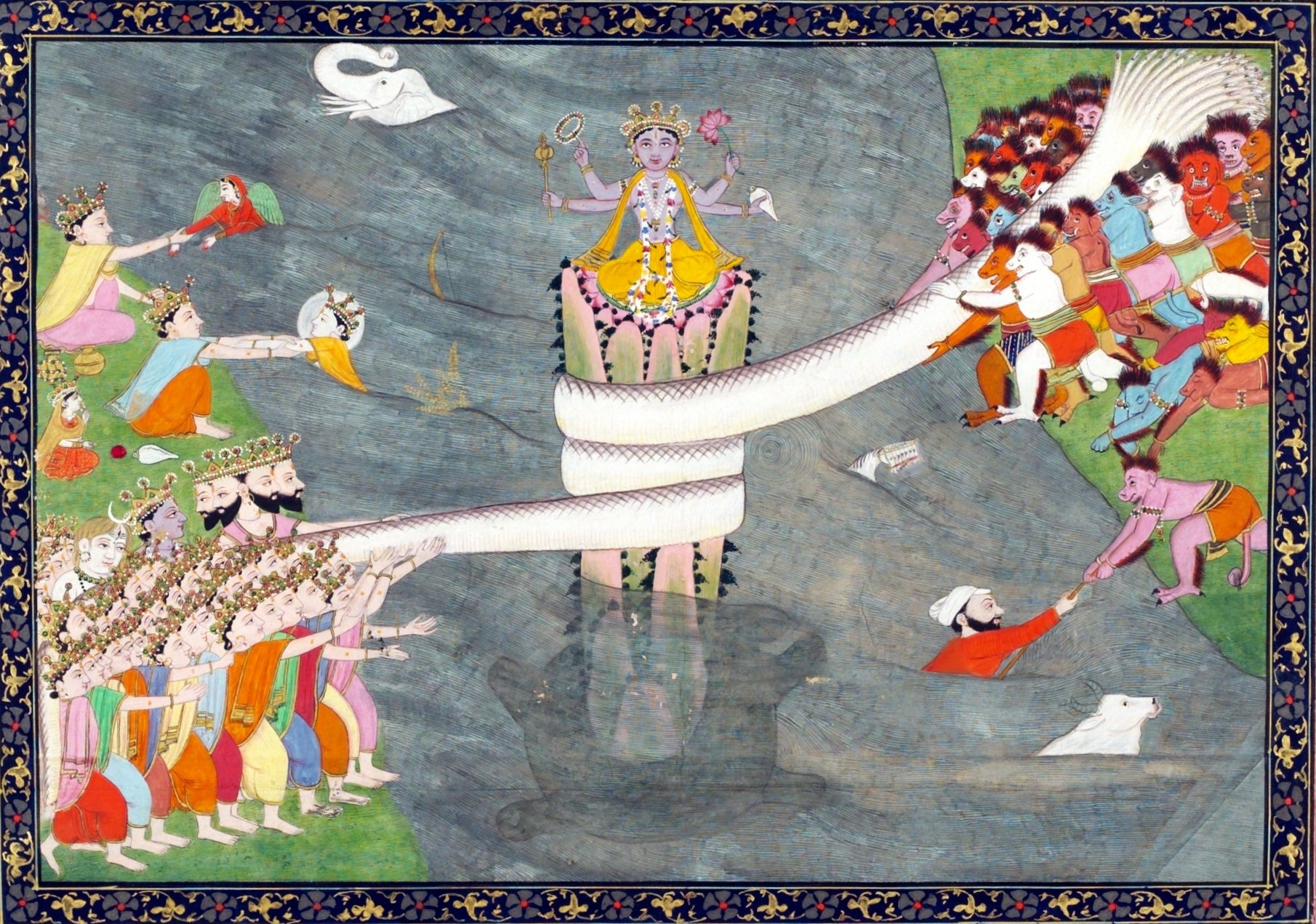
 Surprisingly, the associative chaos is not completely chaotic, for there seems to be a "pattern in delusion"; otherwise nothing coherent could be known about it. In fact, ancient art mirrored this aspect in some way or another. We have for instance the image of the Milky Ocean being churned by two groups of deities that remain on opposite sides of the World Axis, pulling the Serpent, the Cosmic Energy that binds all opposites in chains, as Aphrodita did for the Greeks. 
There are also wise men who became experts in showing the Pillars of Delusion. The famoust example is Siddharta Gautama the Buddha and his teaching about the Four Noble Truths and the co-origination of the Twelve Causes of Existence, which we may examine some day. 
And as the Greeks said, "like attracts the like". All associations are chained by "affinity". Therefore, in the end we are probably responsible for them, since the decision to avoid feeding contaminated associations that lead to suffering and attachment is ours. On the contrary, pure associations can be fostered with attention, and these might even help us to be free. 
Isn´t all this the purpose of true art? Isn´t that the purpose of meditation and reflection? Isn´t the cultivation of "sanity amidst insanity" the most important task of modern humanity? 
Next time we will open a new window to discover if music can really help to bring creative associations and re-connect ourselves to something greater.