Tuesday, July 2, 2013

Illusion


This monumental musical piece, Fantasia on a Theme of Thomas Tallis, composed by Ralph William Vaughan (1872-1958) in 1910, mirrors an intense emotional experience that does not differ much from Life, being a dynamic pallette of contrasts, tensions and release, colours and lights, shadows and darkness, anticipating a style that has come to be abundantly used in contemporary cinema. This "deceptive saturation" of the heart and the senses was one of the main features of the Romantic Era, as  we can also see in XIXth century paintings, like the one we have before our eyes: the famous Wanderer above the Sea of Fog, by Caspar David Friederich. 
This painting is  subject to interesting but opposite interpretations, idea which is not new, since the writer John Lewis Gadiss already pointed it is suggesting at once mastery over a landscape and the insignificance of the individual within it. We see no face, so it's impossible to know whether the prospect facing the young man is exhilarating, or terrifying, or both (Wikipedia).
Yet, there is much more in this painting, worthy of reflection, because it seems to express our situation in life. There are times when existence seems unbelievably beautiful, awe-inspiring, in contrast to the instants of fear, or even horror in some cases. And what to some people appears beautiful, to others can be terrifying. 
We may also think the young Wanderer has reached a “summit” from which the “clouds of life” can be contemplated beyond deception, or, on the contrary, the sense of reaching a summit casts him deeper into the clouds of ignorance, delusion, because, as Non Duality tells, in the end there is not a Supreme State to be reached, for Fullness, Suchness, shines in everything and everywhere. Although this is the most difficult and tricky realisation.
Our “states of being” shape our views of things, just as a caleidoscope shows different geometric patterns as it turns on the light. Life seems to move; our perceptions, thoughts, emotions and feelings seem to fluctuate, but does Reality really move?
Illusion –from the Latin ilusio or in lusio (within the act of playing)– is part of Reality, which plays hide and seek with itself, perhaps to be always itself, unfathomable, without boundaries. 
Can the art of living this deceptive game of Life be expressed as finding blissfull stillness, Being, in movement?

Saturday, June 1, 2013

Deep Listening


In the true listening or “common sense”, sounds, vibrations, are not mere meaningless vibrations, even when they are not organised in a musical form. Audible or not, vibrations hint at the Song behind all songs, at the Silent Space where everything emerges, grows and perishes, at the Intelligent Light where they are perceived. 


In the beginning was the Word-Lógos (John I, 1)

Echoing Empedocles, vibrations are “pledges of the Muse”, and long to be listened to, consciously sent back to their Fountain Source.
How is the vibration of form, colors, smells and tastes? How do our body, thoughts and emotions sound? How is the sound of life and death? What happens when we include effortlessly, without resistance, the sounds we usually find boring or unpleasant? Doesn´t the mind feel an energy and openness that liberates us?

Wednesday, May 1, 2013

Attitude, from Above

Walden Pond near Thoreau's Hut

We think we may be beside ourselves in a sane sense. By a conscious effort of the mind we can stand aloof from actions and their consequences; and all things, good and bad, go by us like a torrent. We are not wholly involved in Nature. I may be either the driftwood in the stream, or Indra in the sky looking down on it. I may be affected by a theatrical exhibition; on the other hand, I may not be affected by an actual event which appears to concern me much more. I only know myself as a human entity; the scene, so to speak, of thoughts and affections; and am sensible of a certain doubleness by which I can stand as remote from myself as from another. However intense my experience, I am conscious of the presence and criticism of a part of me, which, as it were, is not a part of me, but a spectator, sharing no experience, but taking note of it, and that is no more I than it is you. When the play, it may be a tragedy, of life is over, the spectator goes his way. It was a kind of fiction, a work of the imagination only, so far as he was concerned. This doubleness may easily make us poor neighbors and friends sometimes (Walden, Life in the Woods, Ch. Solitude, Henry David, Thoreau, 1854).

The most relevant aspects of our life on earth are often the most subtle, however,  we hardly pay  attention to them. This is even more true with regard to what Henry Thoreau tries to point out here. What does it mean to be beside ourselves in a sane sense? What kind of sublte awareness is he pointing to? In the beginning he refers to an effort of the mind by which we can stay desidentificated from the distractions of life, as simple spectators, but he ends up being more explicit, mentioning an enigmatic doubleness. And experience tells this sense of doubleness implies much more than the mere action of our daily mind. What we look for belongs to a deeper ground; it is “contemplation from Above”,  namely, above the level of conceptual thinking and daily emotions. Seemingly, it only reaches down to us when our being opens up like a flower, welcoming pure impressions. 

Yet, all those truly involved in an inner practice know that the mind and the body together are many times unable to establish contact with such “depth”, because the organism lacks some energy. That´s the point where we should wonder: where do we put our attention? how do we spend the energy? in which situations do we waste it? Surely, if we lived as we should, the necessary “psychic fuel” would be more available, specially when it is more needed, and then the required quality of attention of the mind to itself, to the body and the world in general, would be possible. 
Some wise man said once we never ponder enough, that we never contemplate enough. For this reason, reflections and realizations are something to be always remembered.
Curiously, after a new infusion of life, we may feel eager to continue with silent contemplation and meditations daily, but even then we tend to forget there is something more important, and it is not exactly an effort of the body or the mind but a "lucid attitude" before which human life suddenly appears full of vanity and trifling delusions, that theatrical exhibition  alluded by Thoreau. A “right attitude” was precisely one of the eight aspects of the eightfold path shown by a teacher called Siddharta. Now it is our task to find and cultivate such a humble attitude. Perhaps it is the only way to access the “right attention” and “right understanding”. Needless to say, this attitude has nothing to do with “gaining”  or “achieving” some ideal peaceful state or any other gift for us. The distorted idea we have of ourselves is precisely the root of our delusions and selfish attitudes, which in the end are self-destructive. With them we can neither grow inwardly, nor forgive and bring light in the middle of an insane world. Reasonably, ancient myths and tales insist on telling that only the purity of the heart can lead to Reality.


Tuesday, April 9, 2013

Addendum II: Jesus in Wisdom Traditions


Jesus and his Disciples, by James Tisot (1890)

Last time we left open the possibility of a factual existence of Jesus of Nazareth. However, we did not say he was exactly as history has presented him. So, today, leaving prejudices behind, we move forward, for the Jesus who left footprints on history does not match “the stereotype” of the movies. Even the hypothetical Jewish sources describe a Jesus that was closer to the so-called paganism than to the official Judaism or to the dissolute Christianity of later centuries. Needless to say, the teaching contained in the Gospels has a mystical-esoteric character that puts true Christianity in direct relation with Wisdom traditions rather than with dogmas and institutions.
The proof that Jesus was to some extent known among some circles of early antiquity lies perhaps in certain Stoic philosopher called Mara bar Serapion, who in a letter to his son undoubtedly alludes to Jesus in a very unconventional way. The letter is currently preserved in the British Museum of London and despite it is included in a VIIth century Syriac manuscript, it is dated to the IInd century or end of the Ist, because of its author. In it we read the following:  
What advantage did the Athenians gain from putting Socrates to death? Famine and plague came upon them as a judgment for their crime. What advantage did the men of Samos gain from burning Pythagoras? In a moment their land was covered with sand. What advantage did the Jews gain from executing their wise King? It was just after that their Kingdom was abolished. God justly avenged these three wise men: the Athenians died of hunger; the Samians were overwhelmed by the sea; the Jews, ruined and driven from their land, live in complete dispersion. But Socrates did not die for good; he lived on in the teaching of Plato. Pythagoras did not die for good; he lived on in the statue of Hera. Nor did the wise King die for good; he lived on in the teaching which He had given.[1]
Since Jesus was traditionally regarded as King of the Jews and there is no other wise king that fits into such a context, the letter can only be referring to the man that brought forth the revolutionary Christian teaching amidst a Jewish environment. And the way the philosopher refers to him is everything but apologetic or dogmatic, and similar, by the way, to the reference of Flavius Josephus, who called Jesus “wise man” –something a “conventional christian” would never do, we insist–. 
The other two personages of the letter, Pythagoras and Socrates, are also remarkable figures upon which leyends and myths have been developed for “educational purposes” (i.e Socrates as protagonist of Plato´s dialogues).  Yet today very few would deny the existence of those two men. It is true they were mentioned by philosophers and historians, but so was Jesus, in a lesser degree, of course, since he was certainly an “elusive figure”, as most of the great spiritual teachers of humanity. How much do we know of Siddharta Gautama the Buddha, apart from the legends? 
Scarce is also the information about a Jewish brotherhood known as the Essenes, carriers of the Hebraic mystic teaching and authors of the Dead Sea scrolls. Curiously, there are certain clues indicating Jesus was somehow bound to this group, without belonging to it. One is his lack of communion with the official Judaism of the time, whose hypocrisy and dogmatism he criticized, as the mystic Essenes would do. On the other hand, as the philosopher and ex-pope Joseph Ratzinger already pointed out, Jesus had to follow the Essene calendar, what would explain some aparent contradictions in the gospels. Moreover, it wouldn´t be surprising if Jesus also received his first initiation from the Essenes. This brotherhood might have helped him to “remember his nature” and awaken his full potential. Someone must have done it, for a boy and a young man always need guidance, even if their level of being is remarkable. But that is another story that would require a larger reflection. There have been tones of speculation concerning the “missing years” of Jesus.
Interestingly enough, Galilea was a crossroad that connected the East and the West. And not far from Jesus’ hometown, Nazareth (Matthew 2: 23), there was even a famous and large city called Sepphoris, where mysteric traditions resonated even in the most unexpected places, such as the Synagoge of Sepphoris, which has an interesting mosaic on the floor, an image of the chariot of Helios, the Sun, surrounded by the twelve constellations [2]. Isn´t that a suggestive coincidence?
The man who transmitted the Christian teaching in Galilea surely didn´t ignore these “cultural currents”. And given the nature of the gospels and their concepts, his disciples must have received a profound spiritual training in harmony with different philosophical systems and the ancient language of myth, in order to spread the teaching properly. 
For these and other reasons, it is risky to think Jesus lived all the episodes of the Gospels “literally”; in addition to their “historical level”, these mean several other things, as shown in past articles. To give just one more detail, if the Talmud is really referring to the Christian Jesus, then, maybe he didn´t have twelve disciples either:
Our rabbis taught: Yeshu had five disciples - Mattai, Nakkai, Netzer, Buni, and Todah (Sanhedrin 43a)
In any case, the details concerning the figure of Jesus are not as important as the teaching. Yet, it is important to realize that someone quite extraordinary must have inspired it. This does not come out of the blue, from one day to the other.
First of all, human culture is usually ruled by “inertia” and therefore any transformative change implies “swimming against the current”, what can only be done by very willingful and intelligent individuals, specially in extremely dark ages, as the beginnings of the Christian era. 
A deeper answer is to be found in a Golden Chain of traditions which hand down, since time immemorial, that there are crucial periods of time in which individuals with a very high level of perfection have to be born in order to open “new cycles” and guide humanity. These individuals are described in ancient texts as "embodiments" of different levels of Consciousness and receive different names, depending on their “level of being and source”, the highest of which is Light-Intelligence (Pleroma and Noûs in Gnostic and Hellenistic views respectively). For the Gnostic-Christian tradition Jesus was the most important of these messengers, being the "vessel" for the descent of the so called Son, which dwells in the Fullness of Light or Pleroma. The ancient gnostic Valentinus even pointed out that in the Gospels such a descent appears symbolised by the baptism of Jesus, moment in which Jesus becomes the Christ (Christôs means anointed in Greek,  as the Hebrew term Messiah). Hence the flesh and bones historical Jesus must be distinguished from the Christ, the “archetype” which humans aspire to receive in order to be "saved" from the world of suffering, death and useless repetitions [3]. And this is also the reason why that enigmatic messenger was known as Yeshua, "Saviour". 

In the Hindu tradition the divine messengers incarnated in human bodies receive the name of Avatars [4], which is precisely the appellative given to Jesus in India, where he is compared to the Lord Krishna –the resemblance of words doesn´t seem a coincidence. 
There are also avatars associated to “planets”, such as the prince Siddharta Gautama, who became the Buddha, the Awakened One.
Anyhow, even if there were no evidence at all supporting the existence of messengers –and this is not the case– the teachings attributed to them are still the key to live in Reality, since these are aimed at helping humans to grow fully. In this sense, both the scholastic discussions and “debunking postures”, miss the point completely, and therefore can only contribute to reinforce the state of sleep that enslaves modern humanity.
________________________
[3] The term Anointed (christós, messiah) can be seen as the act of being literally “bathed” by the emanations of energy that come from higher levels of Being, something which implies a process of self-perfection rather than blind belief. 

[4] Not to be confused with the Buddhist concept of Boddhisatva, human soul that after reaching a high level of perfection decides to return to the earth in order to help, out of compassion.


© Copyright 2013

Wednesday, April 3, 2013

Addendum I: In Search Of The Historical Jesus


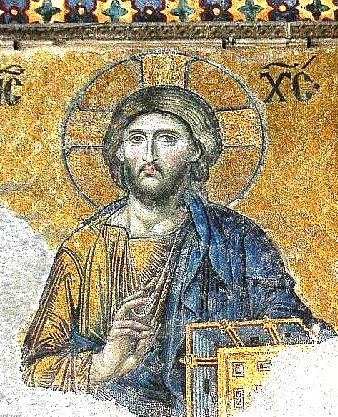
Jesus Pathocrator
Ancient mosaic from Hagia Sophia (Istanbul)


As we said in the first Easter post, sacred scriptures such as the New Testament have seven levels of interpretation and understanding. We focused on two, and now it´s time to deal with its historical protagonist, for the existence of Jesus have been called into question from different viewpoints and none of them seems rigorous or convincing. 

In order to deny the existence of Jesus many researchers simply focus on the few well-known early historical sources that only allude to christians, Christ or Chrestus (i.e Suetonius, Tacitus, Pliny the Younger, etc), and of course on the testimony of the Jewish historian Flavius Josephus (1st century A.D), which despite mentioning “Jesus”, calling him “wise man”, his text is full of “Christian interpolations” that could never be attributed to a Jewish, and it is thereby regarded as a “forgery” (although one could also argue that the expression “wise man” is unthinkable in the mouth of fervent Christians who thought he was, not just the son of God, but God himself, and therefore some parts of the text would really belong to Flavius.)

Other researchers venture to take the astro-theological interpretation as the definitive proof that Jesus did not exist. Probably because many ignore that it is “logically impossible” to prove that something does or did not exist; the laws of reason are very clear in this regard. At most one can suggest “unlikeliness”, but this is not precisely the case here.

We won´t make this too long and will simply mention a few points that are crucial but mostly ignored. 

First of all it would not be serious to discard what seem to be references to Jesus in the Talmud and other Jewish texts. Since these would require extense reflections, we will only mention a few and focus on the one which seems more clear. It is contained in a treatise of the Mishnah, which constitutes part of the Talmud (the Babylonian version in particular) and gathers events and traditions that go far back in time, such as the trials of the Jewish tribunal, the Sanhedrin [1,2,3]:

And it is tradition: On the eve of Passover they hung Jesus the Nazarene [Jeshu ha-Notzeri]. And the crier went forth before him forty days saying: [Jeshu the Nazarene] goeth forth to be stoned, because he hath practiced magic and deceived and led Israel astray. Anyone who knoweth aught in his favor, let him come and declare concerning him. And they found naught in his favor. And they hung him on the eve of the Passover (Sanhedrin 43a). 

This passage, recorded on the 2nd century A.D., is followed by a later commentary  dating from 300 A.D:

Ulla said: 'Would it be supposed that [Jeshu the Nazarene] a revolutionary, had aught in his favor?' He was a deceiver and the Merciful [God] hath said (Deut XIII, 8), ‘Thou shalt not spare, neither shalt thou conceal him’. But it was different with [Jeshu the Nazarene] for he was near the kingdom (Sanhedrin 43a).

Some scholars have argued that the name Jeshu the Nazarene would correspond to a rabbi of 100 B.C that is mentioned in Sanhedrin 107b, but this has been questioned, because the case of such a rabbi appears in other texts without his name. On the contrary, the apellative Nazarene is one of the famoust epithets of Jesus, mentioned in the New Testament (Matthew 2:23), and the Christians were also called Nazarenes in ancient historical texts.

Furthermore, the last sentence of the commentary  may be interpreted as an ironical remark related to one of Jesus´claims: My kingdom is not of this world (John 18:36).

It is also remarkable that this Jeshu of the Talmudic text was “hung” (expression that in those days could perfectly refer to the Roman crucifixion), and right at the same time indicated in the Gospels (John 19:14): the eve of Passover, and due to the same reasons (for attracting the attention of Jews, claiming to be the Messiah, the Son of God, etc).

In 1930 the German scholar Hans Lietzmann published a paper rejecting the historical value of the “trial of Jesus” described in the Gospels. His principal argument was that the Jewish tribunal, the Sanhedrin, was in possession of the ius gladii, namely, the right to execute capital punishment, and since the Gospels state Jesus was crucified by the Romans –forced by the Sanhedrin– the question would be: why didn´t the Jews stone him to death if they had they right to do it? However,  the reason is very simple: 

After the destitution of Herod the Great, governor of Judea (who died in the year 4 B.C), such a province started to be ruled completely by the Romans, and for a long period of time the power of the Sanhedrin was limited. In fact, the Talmud (both the version of Jerusalem and that of Babylon) confirms that “40 years before the destruction of the Temple” –event that happened in 70 A.D–, the “sentences of death” were not passed by the Sanhedrin, for it was forbidden. And the execution mentioned by H.Litzmann, based on an inscription, was an exceptional concession granted by the Romans, as it follows from chronicles of Flavius Josephus (Jewish Ant. XV, 417-Bellum Jud. VI, 124-126). Moreover, this Jewish historian reported a case in which another man called Jesus, son of Ananias, was arrested by the Jews and sent to the Romans to be executed (B.J VI, 300-309).

The other argument that has been proposed against the historical validity of the “trial and crucifixion of Jesus” is based on later comments of the Mishnah, which state the Sanhedrin could not judge and execute offenders in the same day, specially if it was a festive day or the eve of Passover, because the executions had to be done a day after the judgement of death. However, some scholars have realized this law is not applicable at the time of Jesus, because the Jewish leaders were not the Pharisee –who intriduced such a law– but the “strict” Sadducees (with which Jesus argued, according to the gospels; in fact, Caiaphas, the High priest of the Sanhedrin that condemned him, was  a Sadducee). And their law allowed them to judge and execute on the same day. This is, again, supported by Flavius Josephus, who reports about the trial of Herod the Great and his espouse. Herod could only escape because a priest of the Sanhedrin was a good friend of his and postponed the execution for the following day, but his wife was judged and killed on the same day (J.A XIV, 163-184). [5]

It is important to bear in mind that the “Jewish chronicles” are much better testimony than the Roman ones, since the Jews were the enemies of Jesus and did not have any interest in exalting his figure or supporting his existence. As the ancient texts say, for them he was simply a “crank” like those false prophets who walked on those days, and because of his miraculous deeds he was regarded as “a man possessed by devils”. Passages like the following (collected in the 3rd century A.D) seem an echo of this view (in connection with Mark  14:62):

“Rabbi Abahu said: If a man says 'I am God,' he lies; if he says, 'I am the Son of Man' he shall rue it; 'I will go up to heaven,' he saith, but shall not perform it” (Jerusalem Talmud Taanith-65b) [2]

Given such a negative attitude, the Jewish philosopher of religion Pinchas Lapide writes the following: 

“It is quite surprising that the famoust son of Israel, whom the West has regarded as its God, has left scarce, obscure, and often negative traces, in the religious annals of Judaism. In the Talmudic writings –more than 15.000 pages– the figure of Jesus, the Jewish believer, Jesus, is only mentioned in about 15” [4]. 

These allusions were so “incendiary” that in 1631 the Jewish Assembly of Elders in Poland banned the publication of any reference to Jesus of Nazareth in the Mishnah and Gemara, as if they were afraid of them. In this regard, a scholar has written [2]:

At first, deleted portions of words in printed Talmuds were indicated by small circles or blank spaces but, in time, these too were forbidden by the censors. As a result of the twofold censorship the usual volumes of Rabbinic literature contain only a distorted remnant of supposed allusions to Jesus..." (pp.58-59)

"Thankfully, copies of the uncensored pre-1631 texts can be found in Oxford University and several other European libraries. Thus the statements about Jesus were never actually ‘lost’. (Ibid, pp.1-2)

There are other ancient quotes and elements which fit perfectly into the historical nature of Jesus and his circumstances, including passages of the Gospels, but this has been to some extent exposed in books. Although there are profound aspects of the history of Christianity that are usually avoided by most scholars.

In the next article we will see other ancient quotes, including one from Syria, and then we will draw conclusions, some of which can even be supported from sacred traditions.
_________________
Sources:
[1].Jesus of Nazareth. Joseph Klauser. The Macmillan Company, New York, 1925.

[2].Jesus in the Mishnah and the Talmud. Dr. Robert A. Morey (short essay)

[3].He Walked Among Us: Evidence For The Historical Jesus, Josh McDowell & Bill Wilson. Thomas Nelson Publishers-Nashville TN, 1993.
[4].¿No es este el hijo de José? Jesús en el judaísmo actual, Barcelona, 2000, p.90. P.Lapide. 
[5].Los Orígenes Históricos del Cristianismo. José Miguel García, Ediciones Encuentro, S.A. 2007  
[6].Der Prozess Jesu. J.Blinzer, Regensburg, 1969.
[7].Article concerning Jewish references about Jesus:

Sunday, March 31, 2013

Easter Above, Easter Below –Part V

Tympanum of the Romanic Church of St.Trophim

In the end of the sabbath, as it began to dawn toward the first day of the week, came Mary Magdalene and the other Mary to see the sepulchre. And, behold, there was a great earthquake: for the angel of the Lord descended from heaven, and came and rolled back the stone from the door, and sat upon it. His countenance was like lightning, and his raiment white as snow. And for fear of him the keepers did shake, and became as dead men. And the angel answered and said unto the women, Fear not ye: for I know that ye seek Jesus, which was crucified. He is not here: for he is risen, as he said. Come, see the place where the Lord lay. And go quickly, and tell his disciples that he is risen from the dead; and, behold, he goeth before you into Galilee; there shall ye see him: lo, I have told you (Matthew, 28, 1-7).
Surprising is also to notice several coincidences. First of all,  it’s worth wondering why the expression Easter is by itself pointing to the East, where the sun rises and travels along the wheel, Galil, during the year.
And three days after the Winter Solstice –21st, 22nd of December–, comes Christmas, wrongly attributed to the birth of the Judeo-Christian Messiah on the 25th, the date for the celebration of the birth of Mithras, Sol Invictus, the Unconquered Sun or Mythras. From that moment the sun begins its ascent again on the horizon, making the days longer and longer.
Coupled with this, it is relevant to see that when our beautiful Earth reaches its maximum tilt on its two solstices (Summer and Winter), it takes a while to start leaning towards the other way, while it rotates and travels around Helios. Consequently, during this period of "three days" the Sun rises at the same spot and gives the impression of remaining tied to a post, like someone “executed at the stake”. Hence the term "solstice", from the Latin roots “sol” (sun) and "stitium" (stoppage) or "sistere" (to remain).
Thus, it seems no coincidence that before the first solstice, the Gospel says the following:
For as Jonah was three days and three nights in the belly of the great fish; so shall the Son of man be three days and three nights in the heart of the earth. (Matthew 12:40).
Having reached the bottom and dwelled in Darkness for three days, the Solar Hero starts ascending again, “always forward”, leaving the sign of Capricorn behind on the horizon. 

In the nineteenth century some scholars thought this might be the meaning of the Jewish ritual of the two goats, on Yom Kippur. One is sacrificed, while the other is left free into the wilderness, where it climbs on the mountains, carrying away the sins of Israel. And since Jesus was called the Lamb of God which takes away the sin of the world (John I: 29), some interpreters regarded him as the "escapegoat" of the Jewish prophecies (Isaiah 53) [1]. 

In a sense, the goat climbing the mountain would refer to the Sun rising on the new sign. On January 20 Helios enters Aquarius, the Water Bearer –seemingly connected to the famous Son of Man, one of the apellatives of Jesus–. And eventually the He reaches Aries again, Spring, "Easter time", when all began. His resurrection is therefore completed through three signs of Darkness (still Winter), and these are in fact "three days of the Sun", what resonates with the "third day of resurrection". Thus, not even the date of this celebration seems random.
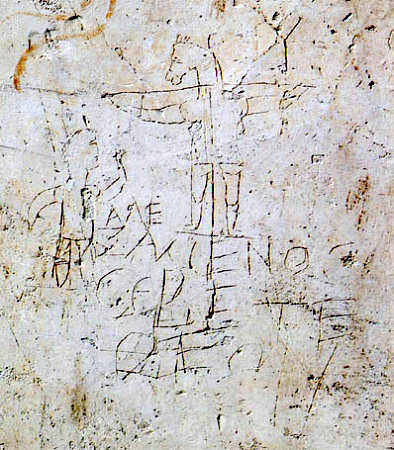
Now, the universe is also within us, because, as Plato explained in the Republic, there are actually three suns: the physical, the psychic fire and the spiritual. Therefore, the solar resurrection is a "rebirth" on three levels. One must die on psychic level, leaving behing the dark passions and the donkey-mind that keeps us tied to vicious circles. And the traveller is called to ride the donkey, as Jesus did in his triumphal entry. The ancient imagery went even further, since another Christian symbol –incomprehensible to many– is the "crucified ass":

Alexemenos Graffito (first century A.D)


Some believe this was a mockery of the figure of Jesus, but that does not seem the case, since there is another historical reference to the Christian worship of this symbol. Moreover, the same teaching existed in Egypt, where Seth was shown crucified, having the head of an ass. Andi it is logical, for he who laughs last, laughs best. In the end the situation is reversed, since the vertical domination of the two donkey stars that appeared in Cancer, disappears when Helios leaves Capricorn. This is perhaps the reason why ancient authors –i.e Plato and Porphyry [2]– regarded Cancer as the Gate of Man –where souls incarnate on earth–, and Capricorn as the Gate of the Gods –where souls return perfected to the Source–.
Most of Jesus' ministry remains untouched in these posts, although it is up to each one to discover the connections in the "soul", studying the four gospels. It is enlightening to see how Jesus' encounter with John the Baptist matches the symbolism of Aquarius, which is followed by Pisces, which is bound to Jesus recruiting his first disciples, "the fishermen".
Before closing Easter, it is worth noting that according to the Gospels, the coming of the Son of Man is a Second Coming of Spirit, and it also has three levels. The Gospels teach that every sincere seeker must receive its baptism of “water” (Psyche), to endure the baptism of Spirit (Pneuma) and that of Fire (Father, Aither). No doubt this is one of the most enigmatic and profound aspects of the teaching, as it is also related to a time that is yet to come, if it has not already begun.
This “internal knocking on the door" relates not to the annual clock we have seen, but to the "precessional" one, which was also marked with the twelve signs of the zodiac. It will surely emerge as a central theme in other posts. Now we just remember that each precessional or Platonic month lasts about 2160 years and receives a different a "solar influence", because the Sun crosses different regions of space travelling around another star, during the Platonic Year (24,000-25,920 years approx) [3] [4]. And according to the precession of the equinoxes, the earth is now abandoning the Platonic Month of Pisces –symbolized by the Christian fish–. However, even though the movement of the stars is measured mathematically, it seems that the solar influence on each Platonic Month always starts before the expected, as mirrored on the evolutive and involutive cycles of humanity. Reasonably, someone very wise said:
Watch therefore, for ye know neither the day nor the hour wherein the Son of man cometh (Matthew 25: 13)
In other words: hands to the plow.
We leave for next week the issue of the historical Jesus, which should be addressed from an unconventional viewpoint.

_____________________
For a bibliography on the topics covered in these series, it is best to read the ancient classics, sacred texts and XIXth century authors (i.e Robert Taylor, Kersey Graves, Frances Rolleston) and then draw the own conclusions. Although the following books were inspiring in this research:
1.Hamlet's Mill: An Essay Investigating the Origins of Human Knowledge and Its Transmission Through Myth. Hertha von Dechend and Giorgio de Santillana, 1969.
2.Serpent in the Sky: The High Wisdom of Ancient Egypt. John Anthony West.

3.The Hero With A Thousand Faces. Joseph Campbell.

4.The Power of Myth. Joseph Campbell and Bill Moyers.

References:
[1].History of constellations, i.e Capricorn:
[2].Explicitly in Porphyry's On the Cave of the Nymphs, and veiled in Plato's Timaeus and The Republic (book X, myth of Er).


[3].The Holy Science. Swami Sri Yukteswar (Vedic astronomy and parallelism between the Christian and Vedic teachings).
[4].Lost Star of Myth and Time. Walter Cruttenden (on the twin star, the sun’s companion).


Saturday, March 30, 2013

Easter Above, Easter Below – Part IV


After the crucifixion,

When the even was come, there came a rich man of Arimathaea, named Joseph, who also himself was Jesus' disciple: he went to Pilate, and begged the body of Jesus. Then Pilate commanded the body to be delivered. And when Joseph had taken the body, he wrapped it in a clean linen cloth, and laid it in his own new tomb, which he had hewn out in the rock: and he rolled a great stone to the door of the sepulchre, and departed (Matthew 27, 56-60).
If we remember, in the astronomical level of understanding, Helios is sacrificed at the Ninth hour, pierced by the arrow of Sagittarius, the sign of the ninth month, November. At his death, Helios descends completely into the bowels of the underworld, the tomb of the Gospel. We are on Winter Solstice, December 21st, point of maximum darkness, shortest day of the year, marked on the sky by Capricorn, the tenth sign –hence December, from the Latin root Deca, ten, was always the tenth month, not the twelfth–. Naturally, this is consistent with the symbolism of Ten, which is the symbol of "completeness", as Pythagoras taught.

And with regard to the underworld, we emphasize it  has a "purifying" character rather than a frightening one. Many ancient cultures describe this dark stage as a journey in which the traveller meets "guardians" that either prey on the weak souls that only consist of lower passions, and therefore lack "spirit", or help the divine-human souls to get rid of the last remnants of dirt, so that these can ascend to the regions of Light. In Egypt and India these guardians were represented with the figure of a Crocodile or a Hippo, or a mixture of both, and these animals were associated with the hybrid sign of the Sea-Goat, Capricorn, also symbol of the "dual nature" of the psyche. It is curious to see how Leonardo Da Vinci himself seems to have mirrored this imagery on the painting we saw before yesterday, the Last Supper, in which the apostle that would correspond to Capricorn makes a peculiar gesture with both arms. What part of a crocodile is it reminiscent of?

Now the next day, that followed the day of the preparation [Sabbath, Saturday], the chief priests and Pharisees came together unto Pilate, saying: Sir, we remember that that deceiver said, while he was yet alive: After three days I will rise again.Command therefore that the sepulchre be made sure until the third day, lest his disciples come by night, and steal him away, and say unto the people, He is risen from the dead  (Matthew 27: 62-64).

And now that the tomb of our Solar Hero has been completely sealed, we can only wait until tomorrow,  to continue with the story. We shall then see how the process takes a surprising twist, where the beginning and end meet, where the stars blend into our soul and open the door to a future of true Hope.